Feeds:
Posts
Comments

Archive for the ‘Photographs’ Category


image-1

Source Wikipedia.
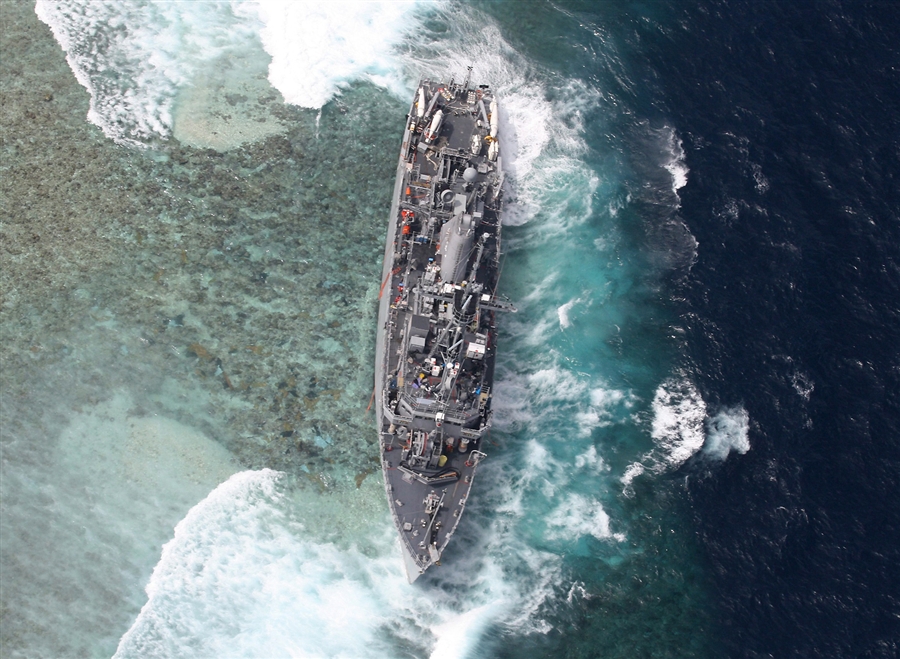
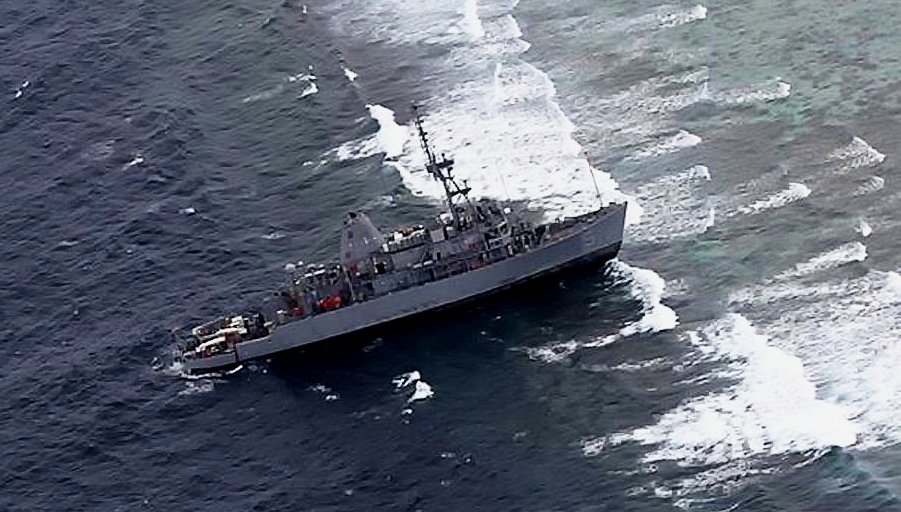
On 17 January 2013 following a port call and fuel stop in Subic, Guardian proceeded across the Sulu Sea and entered the Tubbataha Reefs Natural Park. After appearing on Park radar, at approximately 0400 hours local time Guardian was radioed a warning by park officials that the vessel had entered a restricted area. Park officials claim their lawful warning was met with disregard by Guardian, which radioed back to “bring [their] complaint to the US Embassy.” Shortly thereafter, the captain of the USS Guardian ran his vessel aground on Tubbataha Reef, about 130 kilometres (70 nmi) south east of Palawan in the Philippines. At the time of the accident the ship was travelling from Subic Bay in the Philippines to another port. The extent of any damage to the reef is unknown, but there is no evidence that fuel oil is leaking; damage to the reef has been estimated at 10 meters by the World Wide Fund for Nature Philippines. The U.S. Navy evacuated all 79 crew members from the minesweeper to the USNS Bowditch and MV C Champion on 18 January. On January 19, an assessment team was deployed would plan and execute the vessel’s extraction. On January 20, 2013, the Navy Times reported the ship is taking on water in multiple places and is experiencing a slight list to port.

pb-130120-guardian-cannon_photoblog900a

The comments in the article of the Park Rangers on the Reef calling the USS Guardian by Radio reminded me very much of the following………Click the picture below to play the Video……

.

USS Guardian

.

Read Full Post »


America its time to act

Read Full Post »


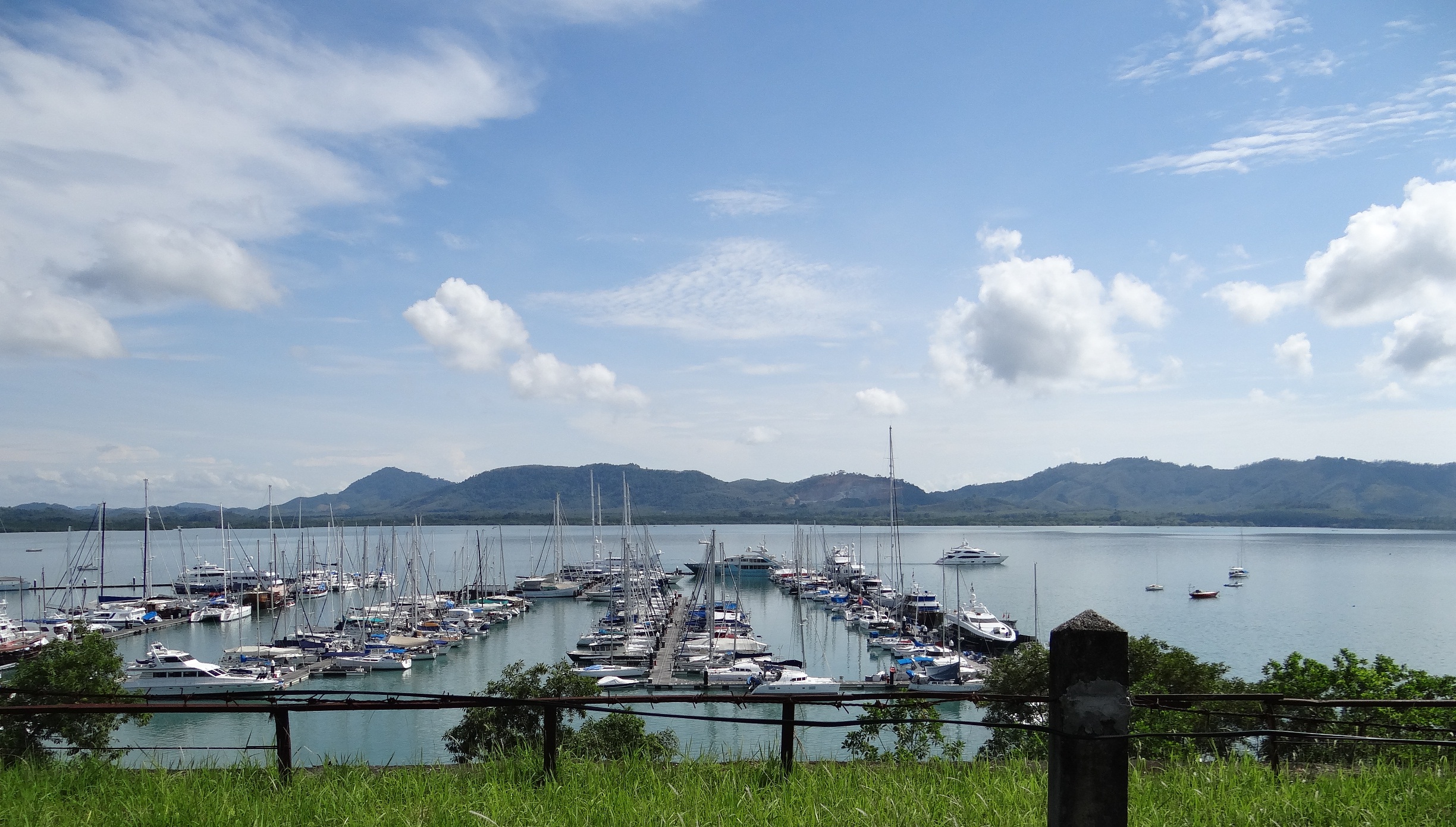
Recently dropped by Yachthaven Marina in Phuket Thailand ……..

and saw some handsome Trawlers berthed there awaiting their next cruise.

First to catch my eye was an “old friend” Seabird a Nordhavn 62, looking like a brand new yacht after some serious TLC at Boat Lagoon.

Her Gelcoat and stainless steel was just sparkling in the strong Thai sunshine. She really did look fantastic. Better than many newer boats in the Marina.

She also had some interesting details for covering the engine exhaust’s in the stack whilst the owners were away overseas !

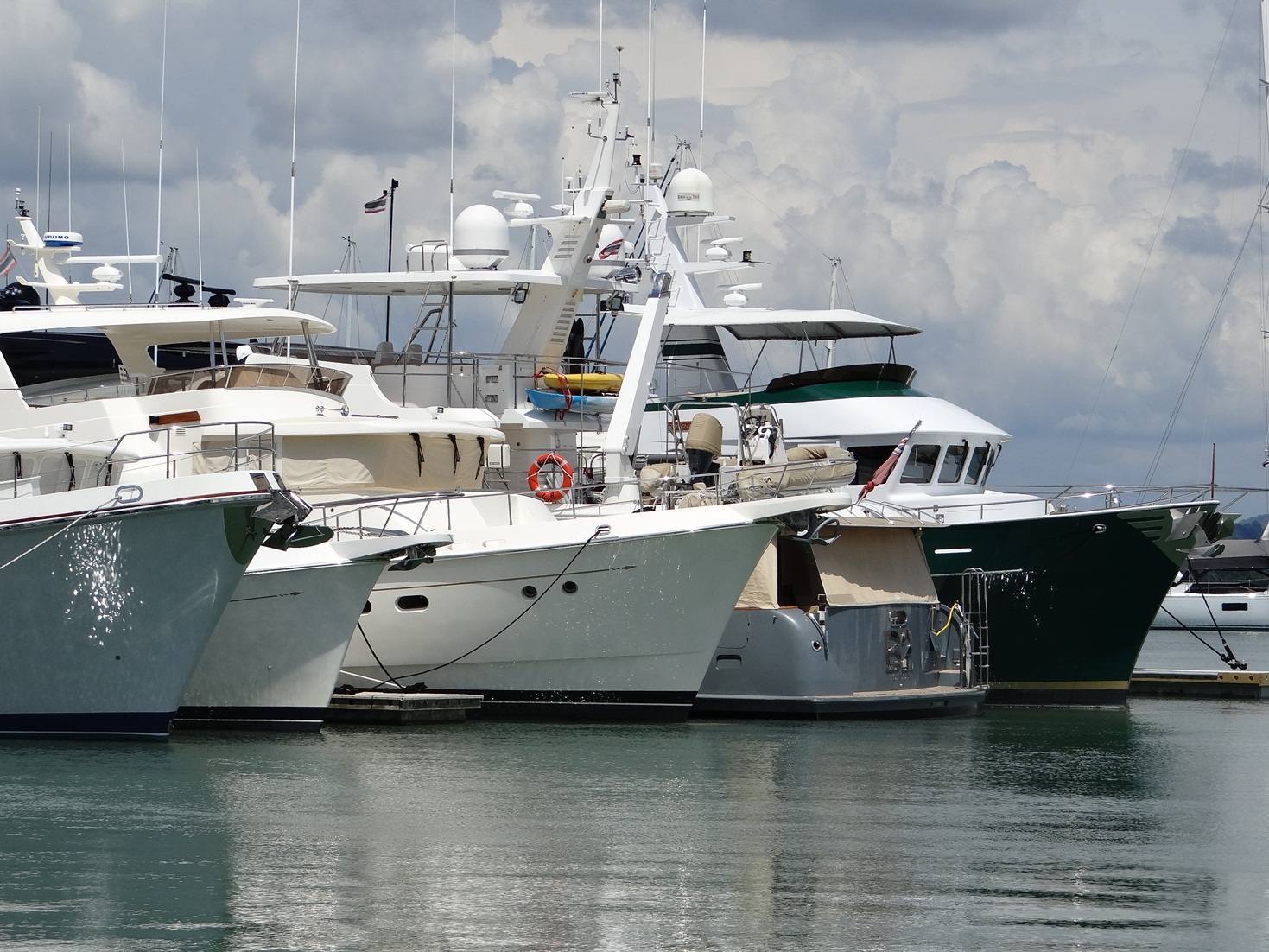
Apart from Seabird, Nordhavn were well represented, with B2 a Nordhavn 64.

That’s what you call “Tight Parking”

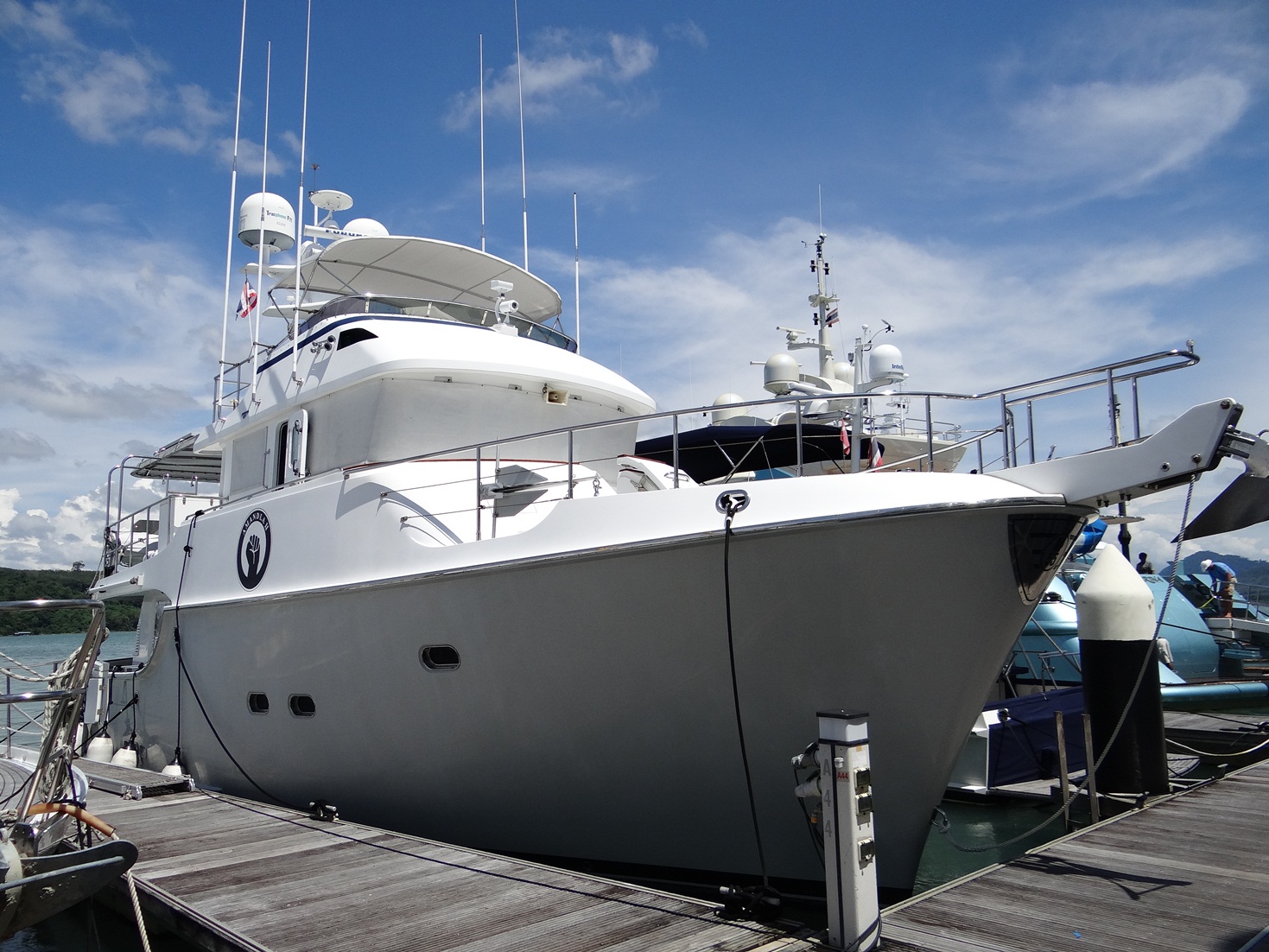
There was also a Nordhavn 55, Amandla.

There were also a pair of Selene’s. Firstly a very tidy Selene 53 – Storyteller V

and right beside her on the other side of the pontoon a Magnificent Selene 66 – Meeandah, shown here hiding behind B2, and making up the other half of the sandwich in that “tight parking” berth.

Lastly was the very capable and very green Northern Marine – Taipan IV

All in all quite an impressive array of Trawlers from 53 feet to over 70 feet LOA.

Read Full Post »


It’s Global Warming, Stupid !

Good Article in Bloomberg Businessweek by By 

It’s Global Warming, Stupid

Yes, yes, it’s unsophisticated to blame any given storm on climate change. Men and women in white lab coats tell us—and they’re right—that many factors contribute to each severe weather episode. Climate deniers exploit scientific complexity to avoid any discussion at all.

Clarity, however, is not beyond reach. Hurricane Sandy demands it: At least 40 U.S. deaths. Economic losses expected to climb as high as $50 billion. Eight million homes without power. Hundreds of thousands of people evacuated. More than 15,000 flights grounded. Factories, stores, and hospitals shut. Lower Manhattan dark, silent, and underwater.

An unscientific survey of the social networking literature on Sandy reveals an illuminating tweet (you read that correctly) from Jonathan Foley, director of the Institute on the Environment at the University of Minnesota. On Oct. 29, Foley thumbed thusly: “Would this kind of storm happen without climate change? Yes. Fueled by many factors. Is storm stronger because of climate change? Yes.” Eric Pooley, senior vice president of the Environmental Defense Fund (and former deputy editor of Bloomberg Businessweek), offers a baseball analogy: “We can’t say that steroids caused any one home run by Barry Bonds, but steroids sure helped him hit more and hit them farther. Now we have weather on steroids.”

In an Oct. 30 blog post, Mark Fischetti of Scientific American took a spin through Ph.D.-land and found more and more credentialed experts willing to shrug off the climate caveats. The broadening consensus: “Climate change amps up other basic factors that contribute to big storms. For example, the oceans have warmed, providing more energy for storms. And the Earth’s atmosphere has warmed, so it retains more moisture, which is drawn into storms and is then dumped on us.” Even those of us who are science-phobic can get the gist of that.

Sandy featured a scary extra twist implicating climate change. An Atlantic hurricane moving up the East Coast crashed into cold air dipping south from Canada. The collision supercharged the storm’s energy level and extended its geographical reach. Pushing that cold air south was an atmospheric pattern, known as a blocking high, above the Arctic Ocean. Climate scientists Charles Greene and Bruce Monger of Cornell University, writing earlier this year in Oceanography, provided evidence that Arctic icemelts linked to global warming contribute to the very atmospheric pattern that sent the frigid burst down across Canada and the eastern U.S.
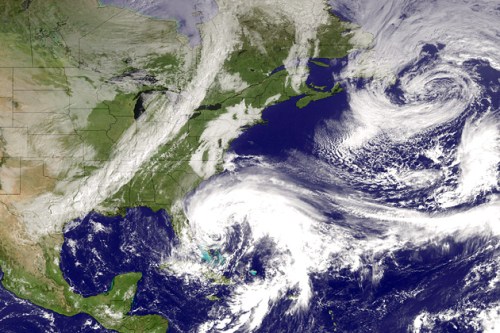
Sandy meets blocking high and cold front

If all that doesn’t impress, forget the scientists ostensibly devoted to advancing knowledge and saving lives. Listen instead to corporate insurers committed to compiling statistics for profit.

On Oct. 17 the giant German reinsurance company Munich Re issued a prescient report titled Severe Weather in North America. Globally, the rate of extreme weather events is rising, and “nowhere in the world is the rising number of natural catastrophes more evident than in North America.” From 1980 through 2011, weather disasters caused losses totaling $1.06 trillion. Munich Re found “a nearly quintupled number of weather-related loss events in North America for the past three decades.” By contrast, there was “an increase factor of 4 in Asia, 2.5 in Africa, 2 in Europe, and 1.5 in South America.” Human-caused climate change “is believed to contribute to this trend,” the report said, “though it influences various perils in different ways.”

Global warming “particularly affects formation of heat waves, droughts, intense precipitation events, and in the long run most probably also tropical cyclone intensity,” Munich Re said. This July was the hottest month recorded in the U.S. since record-keeping began in 1895, according to the National Oceanic and Atmospheric Administration. The U.S. Drought Monitor reported that two-thirds of the continental U.S. suffered drought conditions this summer.
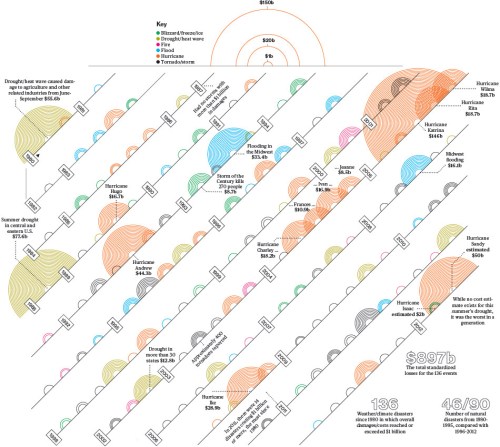
The number of natural disasters since 1996 costing $1 billion or more doubled compared with the previous 15-year period.

Granted, Munich Re wants to sell more reinsurance (backup policies purchased by other insurance companies), so maybe it has a selfish reason to stir anxiety. But it has no obvious motive for fingering global warming vs. other causes. “If the first effects of climate change are already perceptible,” said Peter Hoppe, the company’s chief of geo-risks research, “all alerts and measures against it have become even more pressing.” Which raises the question of what alerts and measures to undertake. In his book The Conundrum, David Owen, a staff writer at the New Yorker, contends that as long as the West places high and unquestioning value on economic growth and consumer gratification—with China and the rest of the developing world right behind—we will continue to burn the fossil fuels whose emissions trap heat in the atmosphere. Fast trains, hybrid cars, compact fluorescent light bulbs, carbon offsets—they’re just not enough, Owen writes.

Yet even he would surely agree that the only responsible first step is to put climate change back on the table for discussion. The issue was MIA during the presidential debates and, regardless of who wins on Nov. 6, is unlikely to appear on the near-term congressional calendar. After Sandy, that seems insane.

Mitt Romney has gone from being a supporter years ago of clean energy and emission caps to, more recently, a climate agnostic. On Aug. 30, he belittled his opponent’s vow to arrest climate change, made during the 2008 presidential campaign. “President Obama promised to begin to slow the rise of the oceans and heal the planet,” Romney told the Republican National Convention in storm-tossed Tampa. “My promise is to help you and your family.” Two months later, in the wake of Sandy, submerged families in New Jersey and New York urgently needed some help dealing with that rising-ocean stuff.
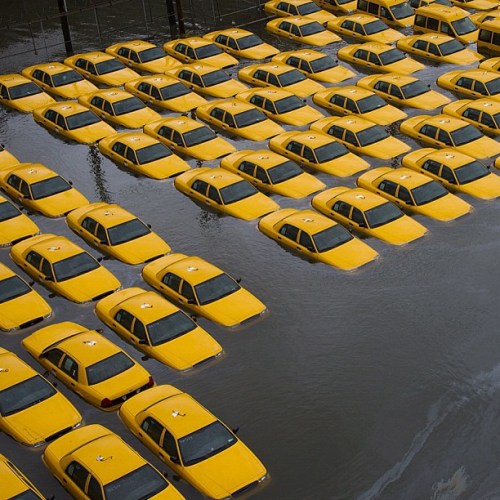
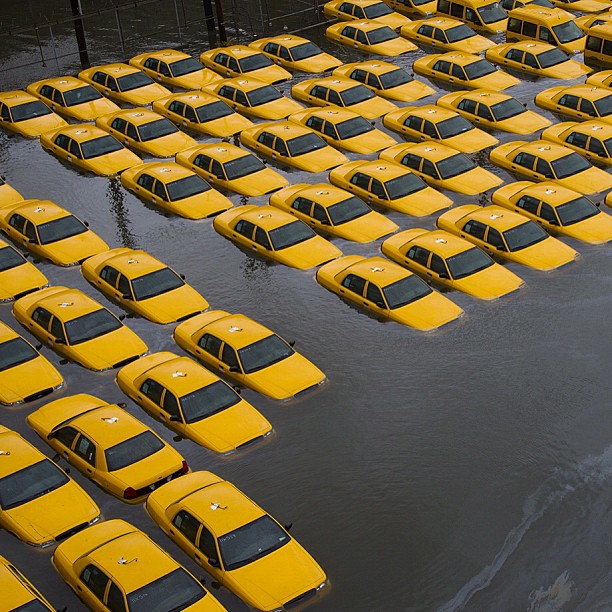
“Taxi for Romney………..”

Obama and his strategists clearly decided that in a tight race during fragile economic times, he should compete with Romney by promising to mine more coal and drill more oil. On the campaign trail, when Obama refers to the environment, he does so only in the context of spurring “green jobs.” During his time in office, Obama has made modest progress on climate issues. His administration’s fuel-efficiency standards will reduce by half the amount of greenhouse gas emissions from new cars and trucks by 2025. His regulations and proposed rules to curb mercury, carbon, and other emissions from coal-fired power plants are forcing utilities to retire some of the dirtiest old facilities. And the country has doubled the generation of energy from renewable sources such as solar and wind.

Still, renewable energy accounts for less than 15 percent of the country’s electricity. The U.S. cannot shake its fossil fuel addiction by going cold turkey. Offices and factories can’t function in the dark. Shippers and drivers and air travelers will not abandon petroleum overnight. While scientists and entrepreneurs search for breakthrough technologies, the next president should push an energy plan that exploits plentiful domestic natural gas supplies. Burned for power, gas emits about half as much carbon as coal. That’s a trade-off already under way, and it’s worth expanding. Environmentalists taking a hard no-gas line are making a mistake.

Conservatives champion market forces—as do smart liberals—and financial incentives should be part of the climate agenda. In 2009 the House of Representatives passed cap-and-trade legislation that would have rewarded more nimble industrial players that figure out how to use cleaner energy. The bill died in the Senate in 2010, a victim of Tea Party-inspired Republican obstructionism and Obama’s decision to spend his political capital to push health-care reform.

Despite Republican fanaticism about all forms of government intervention in the economy, the idea of pricing carbon must remain a part of the national debate. One politically plausible way to tax carbon emissions is to transfer the revenue to individuals. Alaska, which pays dividends to its citizens from royalties imposed on oil companies, could provide inspiration (just as Romneycare in Massachusetts pointed the way to Obamacare).

Ultimately, the global warming crisis will require global solutions. Washington can become a credible advocate for moving the Chinese and Indian economies away from coal and toward alternatives only if the U.S. takes concerted political action. At the last United Nations conference on climate change in Durban, South Africa, the world’s governments agreed to seek a new legal agreement that binds signatories to reduce their carbon emissions. Negotiators agreed to come up with a new treaty by 2015, to be put in place by 2020. To work, the treaty will need to include a way to penalize countries that don’t meet emission-reduction targets—something the U.S. has until now refused to support. If Hurricane Sandy does nothing else, it should suggest that we need to commit more to disaster preparation and response. As with climate change, Romney has displayed an alarmingly cavalier attitude on weather emergencies. During one Republican primary debate last year, he was asked point-blank whether the functions of the Federal Emergency Management Agency ought to be turned back to the states. “Absolutely,” he replied. Let the states fend for themselves or, better yet, put the private sector in charge. Pay-as-you-go rooftop rescue service may appeal to plutocrats; when the flood waters are rising, ordinary folks welcome the National Guard.

It’s possible Romney’s kill-FEMA remark was merely a pander to the Right, rather than a serious policy proposal. Still, the reconfirmed need for strong federal disaster capability—FEMA and Obama got glowing reviews from New Jersey Governor Chris Christie, a Romney supporter—makes the Republican presidential candidate’s campaign-trail statement all the more reprehensible.

The U.S. has allowed transportation and other infrastructure to grow obsolete and deteriorate, which poses a threat not just to public safety but also to the nation’s economic health. With once-in-a-century floods now occurring every few years, New York Governor Andrew Cuomo and New York City Mayor Michael Bloomberg said the country’s biggest city will need to consider building surge protectors and somehow waterproofing its enormous subway system. “It’s not prudent to sit here and say it’s not going to happen again,” Cuomo said. “I believe it is going to happen again.”

David Rothkopf, the chief executive and editor-at-large of Foreign Policy, noted in an Oct. 29 blog post that Sandy also brought his hometown, Washington, to a standstill, impeding affairs of state. To lessen future impact, he suggested burying urban and suburban power lines, an expensive but sensible improvement.

Where to get the money? Rothkopf proposed shifting funds from post-Sept. 11 bureaucratic leviathans such as the Department of Homeland Security, which he alleges is shot through with waste. In truth, what’s lacking in America’s approach to climate change is not the resources to act but the political will to do so. A Pew Research Center poll conducted in October found that two-thirds of Americans say there is “solid evidence” the earth is getting warmer. That’s down 10 points since 2006. Among Republicans, more than half say it’s either not a serious problem or not a problem at all.

Such numbers reflect the success of climate deniers in framing action on global warming as inimical to economic growth. This is both shortsighted and dangerous. The U.S. can’t afford regular Sandy-size disruptions in economic activity. To limit the costs of climate-related disasters, both politicians and the public need to accept how much they’re helping to cause them.

Read Full Post »

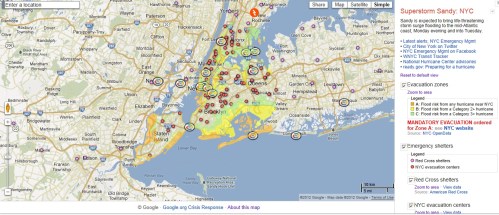
To anyone actually in the area and affected by Sandy, or anyone with friends or family in the area, or just anyone who has an interest in what is happening as a result of #Sandy, and assuming you have access to Electricity and Internet, then check out the Google CrisisMap resource.

Link below.

Google CrisisMap # Sandy ; Storm Surge & Flooding Data

Google CrisisMap Online Resource

Google CrisisMap #Sandy 2012

Read Full Post »


From Zerohedge http://www.zerohedge.com/news/2012-10-29/nations-oldest-nuclear-power-plant-new-jerseys-oyster-creek-declares-alert-following

Quote

As a reminder, the biggest catastrophe that resulted from last year’s Tohoku earthquake in Japan was not the earthquake itself, nor the infrastructure destruction from the susbequent tsunami, but the impact of the soaring water wall on the nuclear power plants in the coastline, namely Fukushima, and its aftermath, by now known all too well to all. So tonight too, all along the east coast, the biggest threat is not the wind, nor the rain, but the impact of the storm surge on the tens of nuclear power plants located in the vicinity of the rapidly rising tide. Such as Oyster Creek in New Jersey which just went on alert due to the surging water level.

From AP:

The nation’s oldest nuclear power plant is on alert after waters from a colossal storm reached high levels.

Oyster Creek in Lacey Township, N.J., was already offline for regular maintenance before Sandy, a superstorm downgraded Monday night from a hurricane, slammed the East Coast.

The Nuclear Regulatory Commission says an “unusual event” was declared around 7 p.m. when water reached a high level. The situation was upgraded less than two hours later to an “alert,” the second-lowest in a four-tiered warning system.

Federal officials say all nuclear plants are still in safe condition. They say water levels near Oyster Creek, which is along the Atlantic Ocean, will likely recede within a few hours.

Oyster Creek went online in 1969 and provides 9 percent of New Jersey’s electricity.

And elsewhere, we just saw the following also very disturbing headline from US Emergency Services:

PA | HYNDMAN |**EVACUATION**| – | VOLUNTARY EVAC DUE TO NUCLEAR WARNING IN BEDFORD COUNTY. UEA325 | UEA451 |

We will keep track of any related news and report as soon as we see it.

Unquote

Read Full Post »


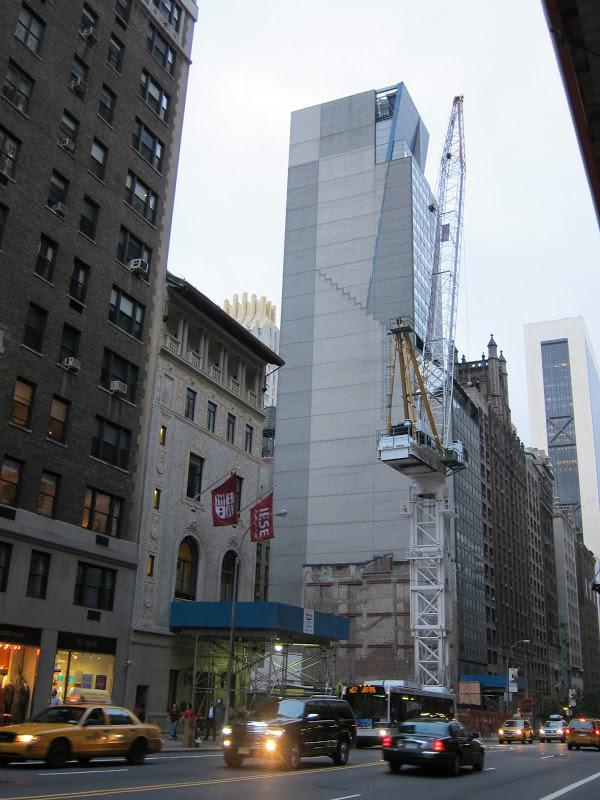
Frankenstorm Sandy is just starting to Flex her muscels and already there is a Media Storm over some of her exploits, including this story about the Damaged Crane that is precariously balanced 90 storeys up above West 57th Street.

I came across this Technical article that goes into a bit of detail about the Tower Crane, and what might happen or be done to recover the situation.

Search Cryptome Privacy, anonymity and security services are deceptive, protect yourself.

NYC crane collapse, at top of 90-story building, West 57th St and 7th Ave, 29 October 2012, 3PM

The weight of the boom and its load is usually balanced by the counterweight. With both on the same side there is danger of breaking the connection to the shaft with the entire lifting rig falling onto surrounding buildings and bouncing to the street along with debris of the buildings hit.

The boom might fall separately leaving the rest of the rig in place, but the upper photo shows the collapsed boom is still attached to the lifting rig and the cables connecting the boom to the lifting machine are quite strong if not weakened by the collapse or by wind-induced abrasion.

There is also a chance the swaying rig will wrench and bend the shaft at a connector or pull the entire shaft away from the building, causing a wider swath of destruction than that of the rig falling, especially to occupied structures. This happened in NYC some years ago with several persons killed.

These accidents, while rare, are anticipated but require quick action to secure the damaged parts, made much more dangerous in this case with the strong storm’s arrival in about two hours.

For damage control, the boom can be secured by a crane rigging team, another crane erected atop the building (parts raised in building elevators), the counterweight and boom disassembled in parts and the components lowered to the ground.

Crane design provides for considerable wracking of the equipment during use, shifting and swinging loads, stops and starts, so there is ample safety factor at crucial elements and connectors. This accident looks as though it can be safely managed if the storm does not make the situation worse. Crane riggers are highly trained, licensed and expert in handling crises. They are a worldwide band of high-rise daredevil safety wizards essential for the skyscraper boom. Meticulous after-accident reports tell what happened and how to minimize recurrence.

It is not known why the boom was not more securely lashed for the storm as customary for imminent hazard.

Below: the crane at the start of construction.

Original post is here:  http://cryptome.org/?b467e680


Read Full Post »


Here is what all the hyperbolae is about >

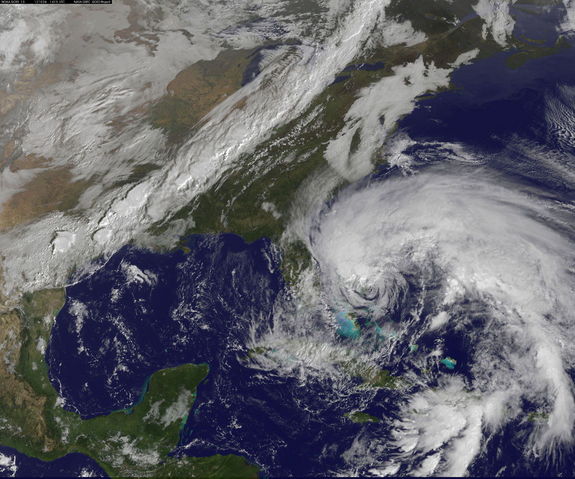
The Satellite Image shows Hurricane Sandy heading straight for a cold front that sits along the entire US Eastern Seaboard. These will combine to generate “Frankenstorm”

Hurricane Sandy, (Cyclone to those in Australia, or Typhoon in Asia) is still tracking to the US eastern seaboard. Only the outside fringes of it have so far reached NYC etc, and already there are reports of flooding and damage.

High tide is still some hours away, and with the Full Moon they will be springs, so severe flooding is assured.

The storm is set to intensify as the eye tracks ever towards the coast and inland, to meet up with the cold ridge along the Eastern Seaboard.

It seems there will likely be severe destruction along it’s path on any exposed or unprotected structures and buildings.

It is reported that the NY subway is already starting to flood and that storm surges are predicted to inundate the barriers.

The NY Stock Exchange will be closed for Tuesday (Monday closed) and it is reported this is the first time since the 1800’s that this has happened.

So, all the doubters, now do you believe in Global Warming affecting the Weather patterns ?

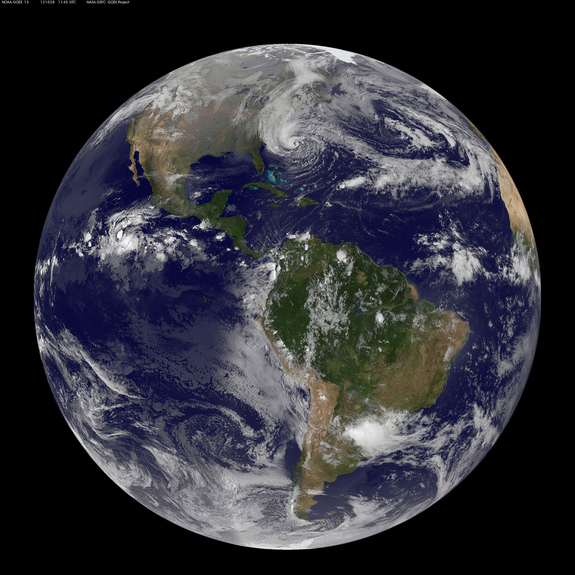
A thousand miles across !!

Global View

Oh Sandy !!

Read Full Post »


Before

TV Reports before

.

After

TV Reports after

Before

Alongside before

After

Alongside after

Before

Navy RIB before

After

Navy RIB after

Before

Builder & Navy look before

After

Navy & Builder look after

Before

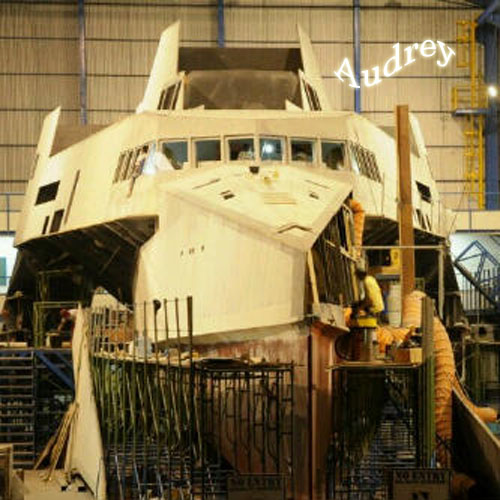
Shell construction before

After

Shell destruction after

Before

63m Fast Missile Trimaran before

After

After ………. Toast !

.

Read Full Post »


Recap.

The Lamma IV, a 24 metre boat owned by Hongkong Electric carrying about 124 staff and their family members, with a crew of 3, travelling to watch Fireworks in Victoria Harbour, collided with the ferry Sea Smooth, in waters off Lamma Island at about 8.23pm on October 1, 2012. More than 100 passengers on the boat fell into the water, and at least 39 are confirmed dead. This is the deadliest boat accident in Hong Kong in 40 years. The Fireworks were scheduled to start at 9.00pm, and attracted around 150 spectator vessels. It was reported the Sea Smooth was travelling around 24 knots and the Lamma IV around 14 knots. Visibility was good. It appears the Sea Smooth Port Bow made contact with the Lamma IV Hull in the area of the Stern Port Quarter, where the Engine room compartment is located. It was reported that the impact caused a hole of 9 sq. metres. The Lamma IV engine compartment became inundated with in rushing sea water, causing the stern to rapidly sink to a depth of 15 metres trapping people inside. Eyewitness reports state the Lamma IV was barely visible as a dark shape after the crash. It’s reported the Sea Smooth stayed for around 5 minutes before leaving the scene. Eyewitness reports state the Lamma IV, sank with it’s Bow sticking out of the water within 5 minutes of the collision.

———————————————————————————————————————-

The following drawing was published in the SCMP. It illustrates the differences between the two vessels that collided, and shows how the Lamma IV,  was very vulnerable to a large breach of the Hull in the Engine Room section, or next aft section, which they have called the Sterntube compartment.

The drawing of the Lamma IV shows Five Bulkheads built into the vessel, each of which would either be a sealed bulkhead with no penetration, or have a watertight door to gain access from one section to the next, such as was likely the case between the Engine Room and the Sterntube section.

In some of the news reports, there has been speculation that watertight doors may have been left open allowing more than one compartment to flood.  The investigation will answer that question. If the Sterntube section did as seems likely flood, then there may be additional reasons for that to happen, including additional cracks or openings in the Hull that allowed seawater into that section.

Some survivors have been quoted in the news papers to say that they felt they only had a minute or two after the collision before the Lamma IV aft passenger section was inundated with sea water, and the stern started to slip below the water.

Based on assumptions of the dimensions of the Lamma IV engine room together with the anticipated water flow with a large opening below the water line, I believe it would only have taken around 1 to 2 minutes for the engine room compartment to be filled with more than 80 to 100 tons of sea water.

It is staggering to realise that an opening of less than one square foot, a metre below the sea surface could allow sea water to rush into the vessel at a rate of around 1,000 gallons per minute. Bear in mind that reports mention the opening in the Lamma IV Hull caused by the impact was around 9 square metres.

If there was one watertight door open between the engine room and the sterntubes compartment then at most it would have taken less than six minutes for the compartment to fill with sea water.

These are ‘broad brush’ estimates based on published tables of ‘Estimated Water Flow Rates’, taking into account the size of opening and fall distance. They are also conservative estimates.

With both compartments filled with well over 100 Tons of seawater, and the buoyancy of the aft section removed, the vessel’s stern would rapidly sink, and the vessel upturn into the Bow Up condition as seen in so many photographs.

Anyone trapped in the passenger compartment in the aft section would now be under several metres of water, in a vessel that is vertical, with loose items freefalling down on top of them. A very perilous situation.

.

To give some support and context to the above assumptions, there follows below an eyewitness report of the aftermath of the collision as recounted by Chris Head, who was seated on the upper open deck of the Sea Smooth. This was published in the SCMP.

Quote

Teacher and Lamma resident Chris Head, 48, who was sitting outside at the back of the upper deck of the Sea Smooth, relived the moment of impact and the harrowing minutes afterwards when he thought his 12-year-old son was aboard the stricken vessel the ferry had hit.

“Visibility was fine, it wasn’t crystal clear, there was that haze, but you could see quite clearly. The water was calm,” he said.

“I just heard this enormous whack. I thought we had hit the biggest wave of all time. The force of the collision toppled me out of my seat, I ended up on my hands and knees on the deck. My first reaction was that of shock, just simply ‘wow! what happened?’ I didn’t know if we had hit a rock, a reef, a lighthouse or what.

“Then, because I was at the back of the ferry, I could see the other boat and realised what could have happened. All I could see was this very dark, silhouetted vessel limping away, it was leaning over to one side. It didn’t seem to me like a ferry, it was so dark, there were no lights on it. I thought it was a fishing boat.

“I couldn’t hear any shouts for help or screams, nothing, the boat was just so dark.

“Initially we were trying to put on our life jackets, so we were more concerned with that. But after a few minutes, probably about five, I could see the end of the boat – I couldn’t tell whether it was the bow or the stern – sticking vertically out of the water and I thought ‘Shit! This is real’.

Unquote

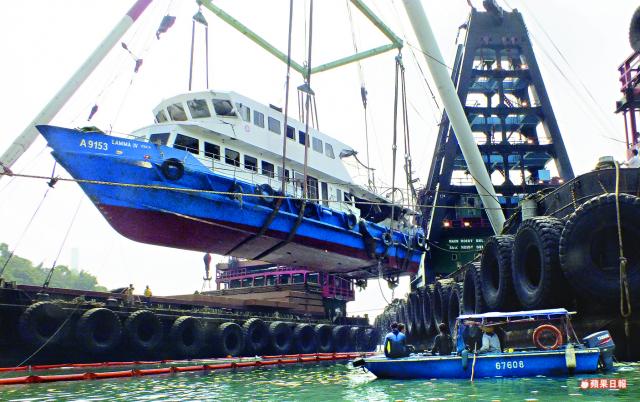
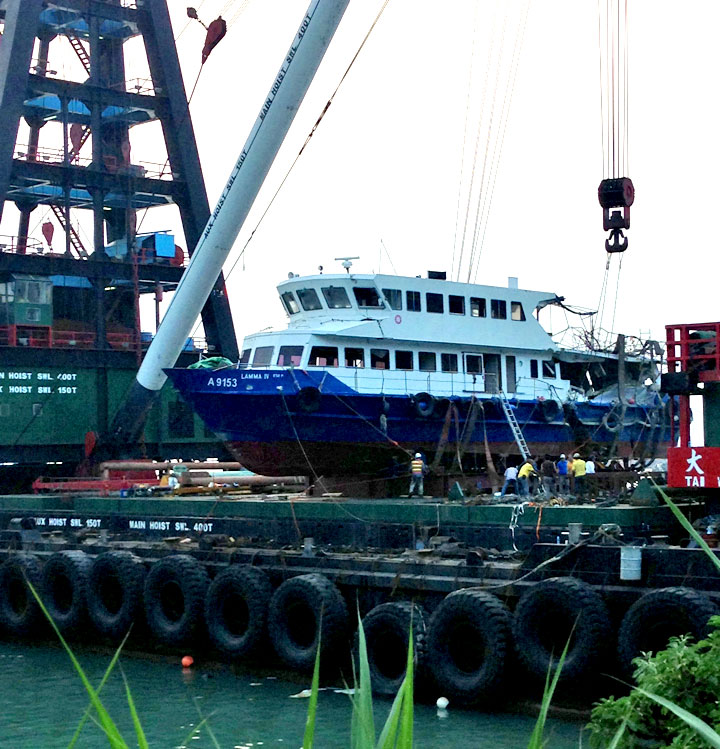
Lastly take a look at the following photographs taken of the Lamma IV as she was lifted onto a Barge to remove her for further investigation.

The massive tear in the Hull caused by the impact can clearly be seen in the Blue Hull. It is also possible the massive impact on the Hull caused other cracks to open further aft.

These are quite chilling photographs as after looking at these it is not hard to imagine just how quickly the stern section would have filled with sea water and sank.

There is an eyewitness report from ‘gac’ on the Lamma Forumn, who saw the Lamma IV as she was lifted onto the barge. He describes the tear in the Lamma IV to be like in an L shape, with a vertical tear from the top of the Hull down to the chine (foot of the side) linking with a horizontal tear along the chine, as illustrated below. In addition there appears for be an opening at the rear bulkhead of the engine room, likely caused by the force of the impact on the Hull shell plate at the time of impact.

.

So in summary the Lamma IV sank so quickly due to the massive breach of her hull. Her fate was sealed the instant the two vessels collided. As soon as the Hull had been ripped open to the extent it was, then rapid flooding and sinking was the only outcome.

Given the force of the impact, any vessel of the same specification and construction as the Lamma IV would surely have had the same outcome.

The tragedy is that the collision took place in the first place, and the Investigation will seek to provide answers to how could that happen, as well as to “Why the Lamma IV sank so quickly”.

The last two Photos are courtesy of contributors of the My Lamma Forumn.

Lastly I’d like to pay my respects to all those affected by this tragic accident with such a sickening loss of life.

Read Full Post »

« Newer Posts - Older Posts »