Feeds:
Posts
Comments

Archive for the ‘Updates’ Category


Before

TV Reports before

.

After

TV Reports after

Before

Alongside before

After

Alongside after

Before

Navy RIB before

After

Navy RIB after

Before

Builder & Navy look before

After

Navy & Builder look after

Before

Shell construction before

After

Shell destruction after

Before

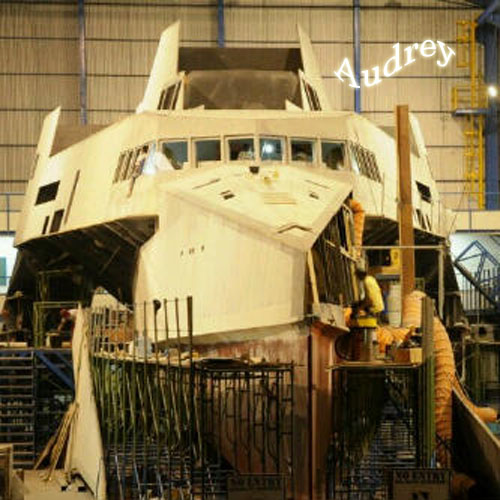
63m Fast Missile Trimaran before

After

After ………. Toast !

.

Read Full Post »


Recap.

The Lamma IV, a 24 metre boat owned by Hongkong Electric carrying about 124 staff and their family members, with a crew of 3, travelling to watch Fireworks in Victoria Harbour, collided with the ferry Sea Smooth, in waters off Lamma Island at about 8.23pm on October 1, 2012. More than 100 passengers on the boat fell into the water, and at least 39 are confirmed dead. This is the deadliest boat accident in Hong Kong in 40 years. The Fireworks were scheduled to start at 9.00pm, and attracted around 150 spectator vessels. It was reported the Sea Smooth was travelling around 24 knots and the Lamma IV around 14 knots. Visibility was good. It appears the Sea Smooth Port Bow made contact with the Lamma IV Hull in the area of the Stern Port Quarter, where the Engine room compartment is located. It was reported that the impact caused a hole of 9 sq. metres. The Lamma IV engine compartment became inundated with in rushing sea water, causing the stern to rapidly sink to a depth of 15 metres trapping people inside. Eyewitness reports state the Lamma IV was barely visible as a dark shape after the crash. It’s reported the Sea Smooth stayed for around 5 minutes before leaving the scene. Eyewitness reports state the Lamma IV, sank with it’s Bow sticking out of the water within 5 minutes of the collision.

———————————————————————————————————————-

The following drawing was published in the SCMP. It illustrates the differences between the two vessels that collided, and shows how the Lamma IV,  was very vulnerable to a large breach of the Hull in the Engine Room section, or next aft section, which they have called the Sterntube compartment.

The drawing of the Lamma IV shows Five Bulkheads built into the vessel, each of which would either be a sealed bulkhead with no penetration, or have a watertight door to gain access from one section to the next, such as was likely the case between the Engine Room and the Sterntube section.
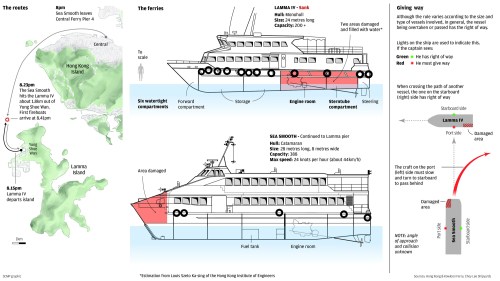
In some of the news reports, there has been speculation that watertight doors may have been left open allowing more than one compartment to flood.  The investigation will answer that question. If the Sterntube section did as seems likely flood, then there may be additional reasons for that to happen, including additional cracks or openings in the Hull that allowed seawater into that section.

Some survivors have been quoted in the news papers to say that they felt they only had a minute or two after the collision before the Lamma IV aft passenger section was inundated with sea water, and the stern started to slip below the water.

Based on assumptions of the dimensions of the Lamma IV engine room together with the anticipated water flow with a large opening below the water line, I believe it would only have taken around 1 to 2 minutes for the engine room compartment to be filled with more than 80 to 100 tons of sea water.

It is staggering to realise that an opening of less than one square foot, a metre below the sea surface could allow sea water to rush into the vessel at a rate of around 1,000 gallons per minute. Bear in mind that reports mention the opening in the Lamma IV Hull caused by the impact was around 9 square metres.

If there was one watertight door open between the engine room and the sterntubes compartment then at most it would have taken less than six minutes for the compartment to fill with sea water.

These are ‘broad brush’ estimates based on published tables of ‘Estimated Water Flow Rates’, taking into account the size of opening and fall distance. They are also conservative estimates.

With both compartments filled with well over 100 Tons of seawater, and the buoyancy of the aft section removed, the vessel’s stern would rapidly sink, and the vessel upturn into the Bow Up condition as seen in so many photographs.

Anyone trapped in the passenger compartment in the aft section would now be under several metres of water, in a vessel that is vertical, with loose items freefalling down on top of them. A very perilous situation.

.

To give some support and context to the above assumptions, there follows below an eyewitness report of the aftermath of the collision as recounted by Chris Head, who was seated on the upper open deck of the Sea Smooth. This was published in the SCMP.

Quote

Teacher and Lamma resident Chris Head, 48, who was sitting outside at the back of the upper deck of the Sea Smooth, relived the moment of impact and the harrowing minutes afterwards when he thought his 12-year-old son was aboard the stricken vessel the ferry had hit.

“Visibility was fine, it wasn’t crystal clear, there was that haze, but you could see quite clearly. The water was calm,” he said.

“I just heard this enormous whack. I thought we had hit the biggest wave of all time. The force of the collision toppled me out of my seat, I ended up on my hands and knees on the deck. My first reaction was that of shock, just simply ‘wow! what happened?’ I didn’t know if we had hit a rock, a reef, a lighthouse or what.

“Then, because I was at the back of the ferry, I could see the other boat and realised what could have happened. All I could see was this very dark, silhouetted vessel limping away, it was leaning over to one side. It didn’t seem to me like a ferry, it was so dark, there were no lights on it. I thought it was a fishing boat.

“I couldn’t hear any shouts for help or screams, nothing, the boat was just so dark.

“Initially we were trying to put on our life jackets, so we were more concerned with that. But after a few minutes, probably about five, I could see the end of the boat – I couldn’t tell whether it was the bow or the stern – sticking vertically out of the water and I thought ‘Shit! This is real’.

Unquote

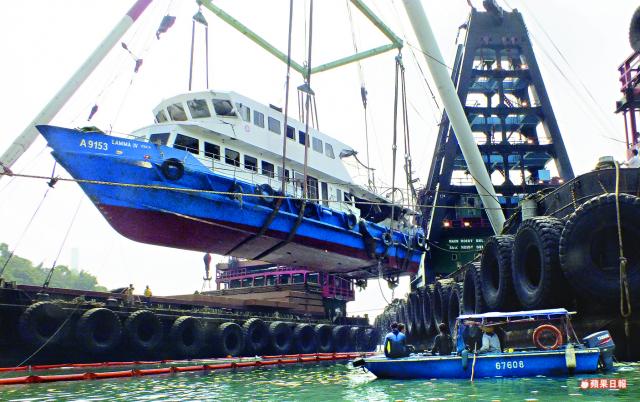
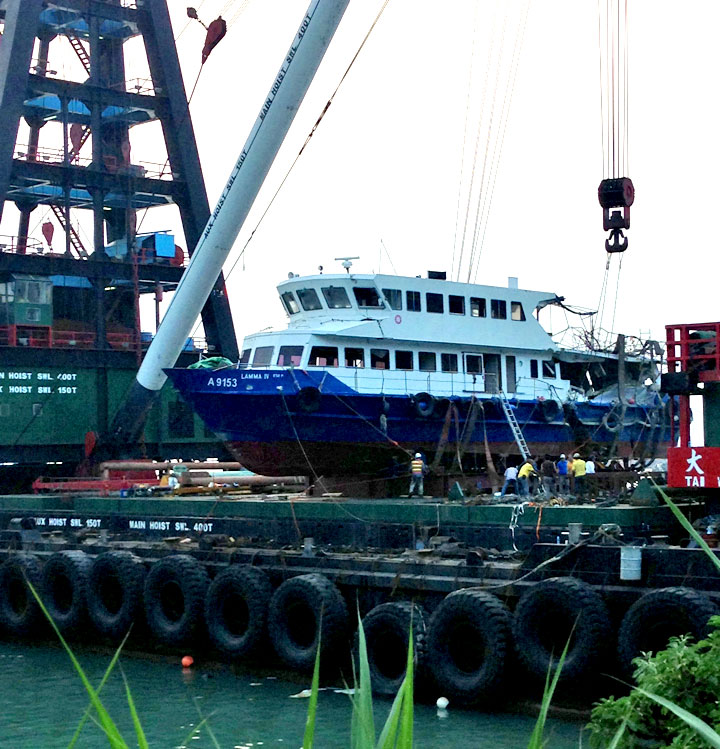
Lastly take a look at the following photographs taken of the Lamma IV as she was lifted onto a Barge to remove her for further investigation.

The massive tear in the Hull caused by the impact can clearly be seen in the Blue Hull. It is also possible the massive impact on the Hull caused other cracks to open further aft.
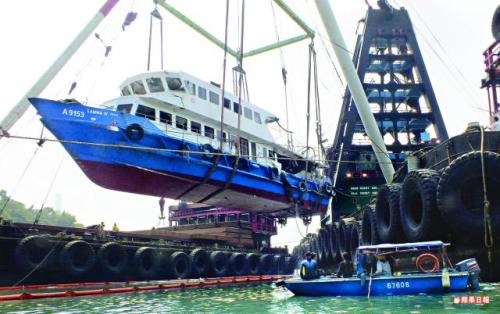
These are quite chilling photographs as after looking at these it is not hard to imagine just how quickly the stern section would have filled with sea water and sank.

There is an eyewitness report from ‘gac’ on the Lamma Forumn, who saw the Lamma IV as she was lifted onto the barge. He describes the tear in the Lamma IV to be like in an L shape, with a vertical tear from the top of the Hull down to the chine (foot of the side) linking with a horizontal tear along the chine, as illustrated below. In addition there appears for be an opening at the rear bulkhead of the engine room, likely caused by the force of the impact on the Hull shell plate at the time of impact.

.

So in summary the Lamma IV sank so quickly due to the massive breach of her hull. Her fate was sealed the instant the two vessels collided. As soon as the Hull had been ripped open to the extent it was, then rapid flooding and sinking was the only outcome.

Given the force of the impact, any vessel of the same specification and construction as the Lamma IV would surely have had the same outcome.

The tragedy is that the collision took place in the first place, and the Investigation will seek to provide answers to how could that happen, as well as to “Why the Lamma IV sank so quickly”.

The last two Photos are courtesy of contributors of the My Lamma Forumn.

Lastly I’d like to pay my respects to all those affected by this tragic accident with such a sickening loss of life.

Read Full Post »


Recap.

The Lamma IV, a 24 metre boat owned by Hongkong Electric carrying about 124 staff and their family members, with a crew of 3, travelling to watch Fireworks in Victoria Harbour, collided with the ferry Sea Smooth, in waters off Lamma Island at about 8.23pm on October 1, 2012. More than 100 passengers on the boat fell into the water, and at least 39 are confirmed dead. This is the deadliest boat accident in Hong Kong in 40 years. The Fireworks were scheduled to start at 9.00pm, and attracted around 150 spectator vessels. It was reported the Sea Smooth was travelling around 24 knots and the Lamma IV around 14 knots. Visibility was good. It appears the Sea Smooth Port Bow made contact with the Lamma IV Hull in the area of the Stern Port Quarter, where the Engine room compartment is located. It was reported that the impact caused a hole of 9 sq. metres. The Lamma IV engine compartment became inundated with in rushing sea water, causing the stern to rapidly sink to a depth of 15 metres trapping people inside. Eyewitness reports state the Lamma IV was barely visible as a dark shape after the crash. It’s reported the Sea Smooth stayed for around 5 minutes before leaving the scene.

Good Visibility on Night of Accident

.

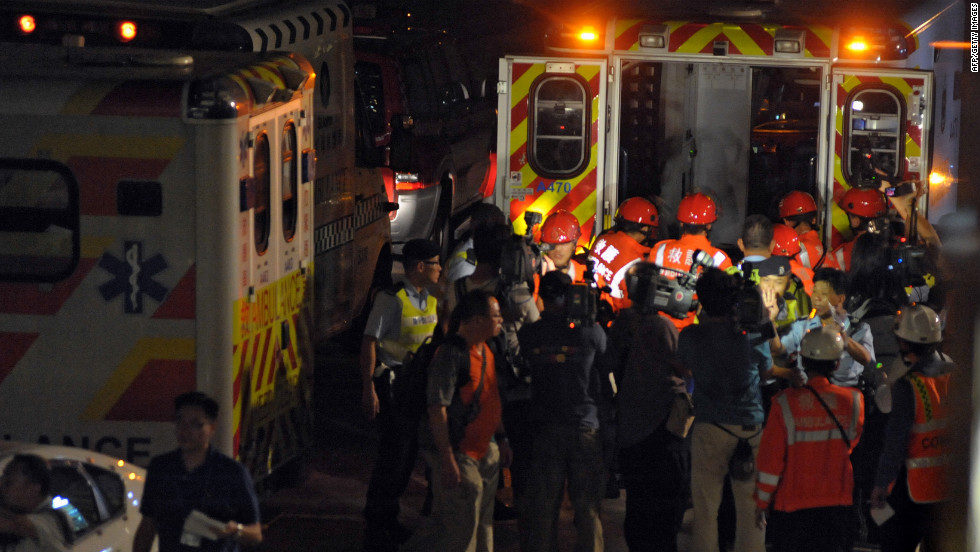
The scene that greeted rescue crews arriving at the sinking ferry off Lamma Island on Monday night was the stuff of nightmares.

“It was chaos,” a senior fire officer said yesterday. “The survivors were aged from young to old and most of them were not wearing lifejackets.”

The unstable state of the stricken ferry, poor visibility and obstructions also hampered efforts by divers as they searched under the water, he said.

Unstable Ferry, Darkness, Murky Waters & Confusion.

On land, things were scarcely better for ambulance officers, who were hampered in their efforts to get survivors to hospital by a manpower shortage.

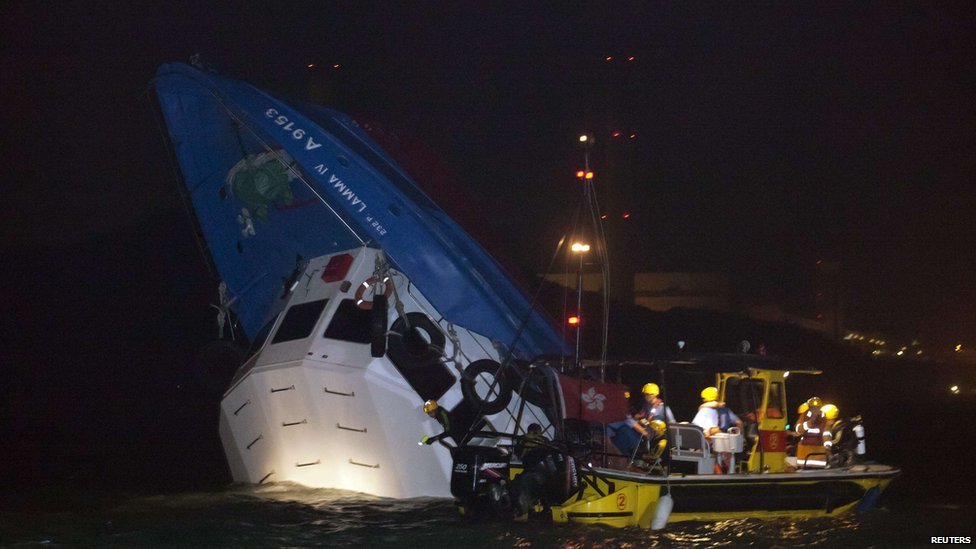
The 24-metre Lamma IV sank vertically to a depth of 15 metres with only its bow above the surface.

Survivors pulled out of the water were put on passing vessels, fireboats and police launches before being taken to five hospitals for treatment.

Fire Services Department divers entered the sunken boat to search for victims.

“In the vessel, visibility was very poor and our divers had to search by hand,” the fire officer said. “There was a lot of debris including furniture that caused obstruction. We had to remove it piece by piece before searching each room.”

The two-deck sunken vessel was unstable and divers worked in the knowledge that it could sink further. At about 3am a barge was called in to secure the vessel.

The bodies of 26 victims were found on the upper and lower decks of the Lamma IV before the search was completed at noon.

With visibility of about a metre, divers yesterday were continuing their search for missing persons on the seabed.

Chan Shi-ki, chairman of the Fire Services Department Ambulancemen’s Union, said there was a shortage of ambulances and officers during the rescue and some ambulances were drafted in from as far away as the New Territories.

“It was very chaotic. Many ambulances had to work cross-district,” he said. “But this is very risky. Seriously injured patients might die from loss of blood if ambulances cannot arrive within 12 minutes.”

Chan said some ambulances called in from Ma On Shan did not arrive as they were diverted to handle cases in Kowloon.

Because of a manpower shortage, some patients were handled by firemen and St John Ambulance volunteers.

“From an ambulance man’s point of view, it is best for patients to be handled by us,” Chan said. “If there are enough officers, we do not need help from St John Ambulance.”

Officers on the midday shift worked from 11am to 11pm and had no time for dinner, he said.

Ambulance Service

Main Article : SCMP

Read Full Post »


Recap :

A boat owned by Hongkong Electric carrying more than 100 staff workers and their family members collided with a ferry in waters off Lamma Island at about 8.23pm on October 1, 2012. More than 100 passengers on the boat fell into the water,  and at least 39 are confirmed dead. This is the deadliest boat accident in Hong Kong in 40 years. The Fireworks were scheduled to start at 9.00pm.

The decision to go ahead with the National Day fireworks display 30 minutes after the ferry collision has caused much debate online.

Some argued the government was trying not to spoil the happy mood of the holiday, while others thought the administration was trying to cover up the accident.

Some said the display had to take place because more than 300,000 people had gathered around the harbour, waiting for the show, and cancelling it could have created a problem.

The Marine Department said there were 150 vessels in the harbour waiting for the fireworks.

The debate also extended to whether the city should stage fireworks displays at future National Days, which they said should become a day to mourn the victims of the tragedy.

Other online forum commentators asked why the nightly Symphony of Lights show was not cancelled immediately and why a day of mourning was not called immediately after the collision.

A spokesman for the Home Affairs Bureau, which co-ordinates the fireworks display, defended the decision to go ahead. He said the crash happened less than an hour before the fireworks show started at 9pm. It took time to receive details about the crash.

He said that if the show was to have been cancelled, the department would have needed to make an announcement to the city, especially with hundreds of thousands of people gathering on the harbour. A cancellation might have made it difficult to disperse the crowds safely.

Faced with the question on Tuesday, Chief Executive Leung Chun-ying said it should be referred to the “show’s organiser”.

The fireworks sponsor was the Association of the Hong Kong Members of Guangdong’s Chinese People’s Political Consultative Conference Committees

Arctile from SCMP here

Read Full Post »


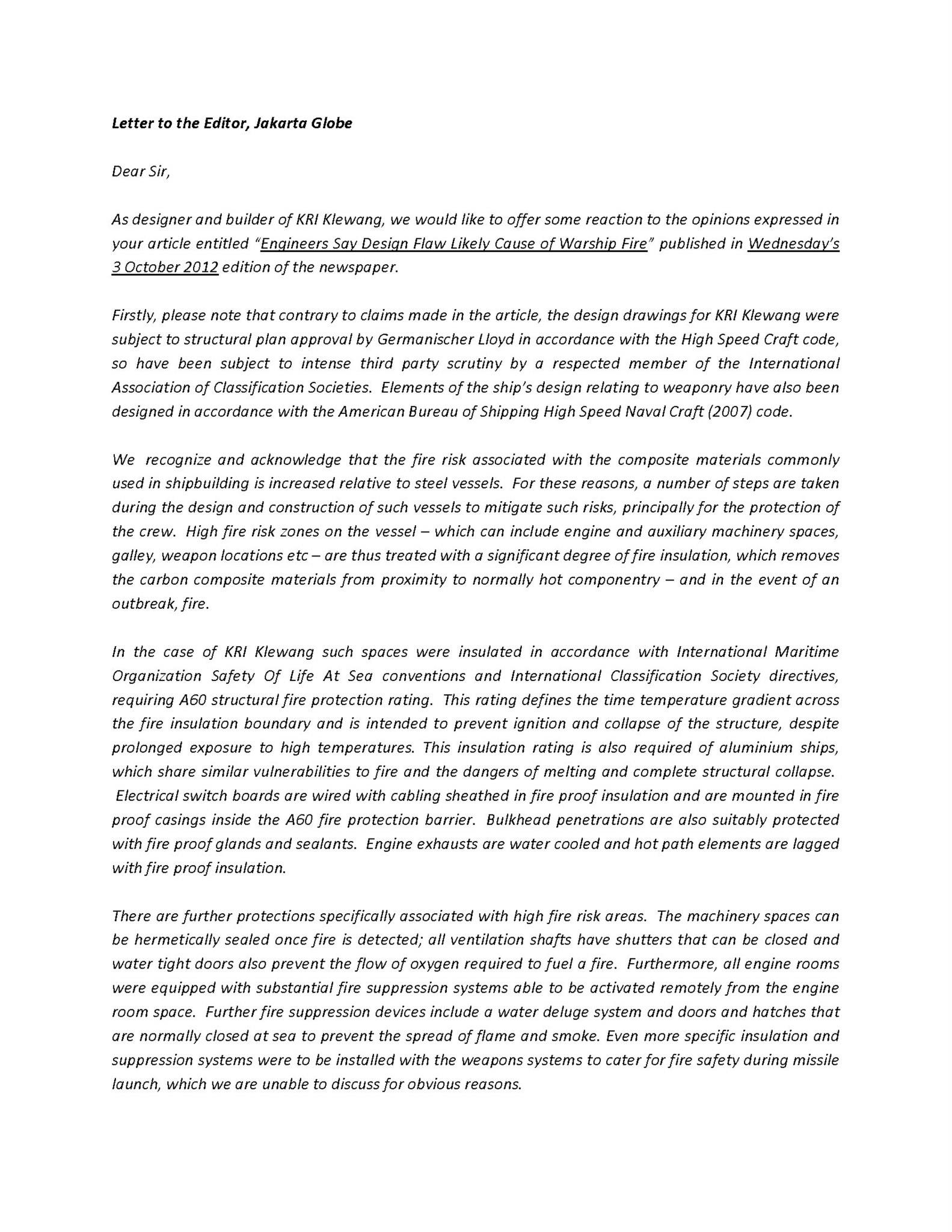
Copy of Letter from the Builder (Lundin) & Designer (Lomocean).

Read Full Post »


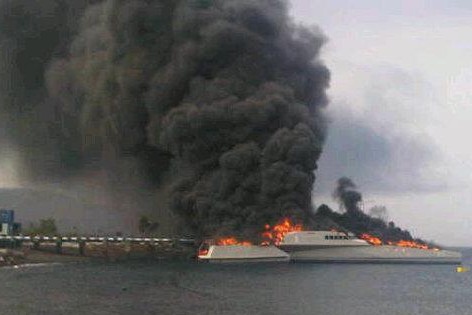
The following You Tube Videos show the KRI Klewang Fire and aftermath.

Eyewitness Video that runs for about 15 mins. includes Fire Response activity and the collapse of side hulls.

http://www.youtube.com/watch?v=IgN5IMNWbXA

News Report on the KRI Klewang fire. Includes Video of the scene of the aftermath of the KRI Klewang Fire. Report in Indonesian.

http://www.youtube.com/watch?v=xbB4AFPFk-M

Miscellaneous News and Eyewitness Videos showing the fire from different angles.

http://www.youtube.com/watch?v=sPRrgXId-0c&feature=endscreen&NR=1

http://www.youtube.com/watch?v=3xRwc_yGdXM&feature=endscreen&NR=1

http://www.youtube.com/watch?v=sPRrgXId-0c&feature=relmfu

http://www.youtube.com/watch?v=V0OkvSIPakg&feature=related

http://www.youtube.com/watch?v=pk-SIKhM78w&NR=1&feature=endscreen

Read Full Post »


ScandAsia. Indonesia News, 11 October 2012 | news Wachiraporn Janrut

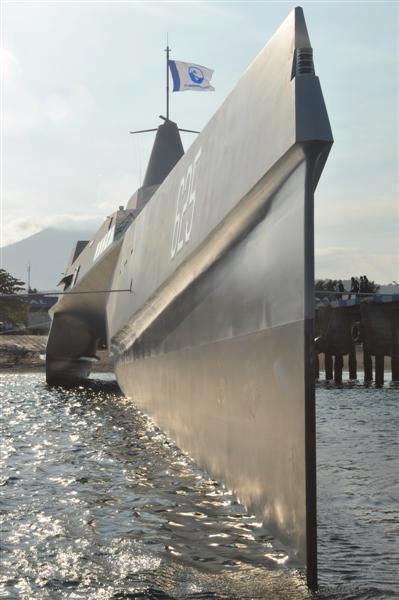
While investigations are pending and the cause of fire on KRI Klewang remains unclear, news about the Indonesian’s stealth warship caught fire on 28 September has raised questions in the Indonesian press about whether the design of the vessel was flawed.

In reply to these speculations, Swedish PT Lundin Industry Invest and LOMOcean Design, builder and designer of KRI Klewang for Indonesian’s Navy, have made a statement.

According to the statement, the design drawings for KRI Klewang were subject to structural plan approval by Germanischer Lloyd in accordance with the High Speed Craft code, so have been subject to intense third party scrutiny by a respected member of the International Association of Classification Societies. Elements of the ship’s design relating to weaponry have also been designed in accordance with the American Bureau of Shipping High Speed Naval Craft (2007) code.

It also states that number of steps are taken during the design and construction to mitigate fire risks and that high fire risk zones on the vessel are treated with a significant degree of fire insulation, which removes the carbon composite materials from proximity to normally hot componentry – and in the event of an outbreak, fire.

The companies believe that the carbon fibre material itself does not contribute significantly to the fire load and the fire was not caused by a lack of design standards compliance and poor implementation of risk mitigation measures such as fire protection and suppression systems.

In the end of the statement, they reinforce that the KRI Klewang project represents a significant step forward by Indonesia in naval technology which opens the door to a bold, new and innovative future.

Original Article here.

Read Full Post »

Jakarta Globe |  October 10, 2012

The makers of a cutting-edge Navy missile boat that was gutted by a blaze last month have stressed that stringent safety measures were built into the design of the vessel and that a combination of external factors were to blame for the fire.
In a letter to the Jakarta Globe, John Lundin, president of Lundin Industry Invest, said the designers of the KRI Klewang recognized that its carbon-fiber hull made it more susceptible to fire than steel-hulled vessels, and took the appropriate measures to mitigate the risk.
“High fire-risk zones on the vessel — which can include engine and auxiliary machinery spaces, galley, weapon locations, etc. — are thus treated with a significant degree of fire insulation, which removes the carbon composite materials from proximity to normally hot componentry — and in the event of an outbreak, fire,” he said.
He added that fire insulation for the KRI Klewang, built at Lundin’s shipyard in Banyuwangi, East Java, complied with International Maritime Organization Safety of Life at Sea conventions and International Classification Society directives.
This includes sheathing electrical switchboards in fireproof insulation and mounting them in fireproof casings, as well as water-cooling engine exhausts.
“There are further protections specifically associated with high fire-risk areas,” Lundin said.
“The machinery spaces can be hermetically sealed once fire is detected; all ventilation shafts have shutters that can be closed and watertight doors also prevent the flow of oxygen required to fuel a fire. Furthermore, all engine rooms were equipped with substantial fire suppression systems able to be activated remotely from the engine room space.”
When the fire, whose cause Lundin said was still being investigated, broke out on Sept. 28, the boat was docked for maintenance and calibration work in preparation for sea trials.
“In this condition, all ventilation hatches for the ship and engine rooms were open and maintenance crew were on board,” Lundin said.
“The presence of personnel in the engine room prevented the full shutdown of the engine room and discharge of automatic systems that would have suppressed the fire; to do so would have resulted in loss of life, because fire suppression gases will not sustain human respiration.”
He said that although the personnel almost managed to put out the fire, “loss of electrical power following the fault meant that these personnel were exposed to difficult conditions of nil lighting and high smoke levels, which forced them from the area for fear of incapacitation.”
He added that the crew managed to evacuate safely, but “was not trained to shut down ventilation shutters and hatches, nor to initiate remotely operated onboard fire suppression systems.”
“In this condition, the fire was able to propagate throughout the interior volume of the vessel,” Lundin said.
He added that the setback should not stop efforts to keep forging ahead with the latest naval technology.
“This ship offered tactical and operational advantages to Indonesia’s Navy that are simply not achievable with traditional shipbuilding materials, benefits that cannot be ignored in the future,” he said.

Original Article here

Read Full Post »

This from SCMP.

Location of tragedy highlighted as potential flashpoint by marine officials

Sunday, 07 October, 2012, 12:00am

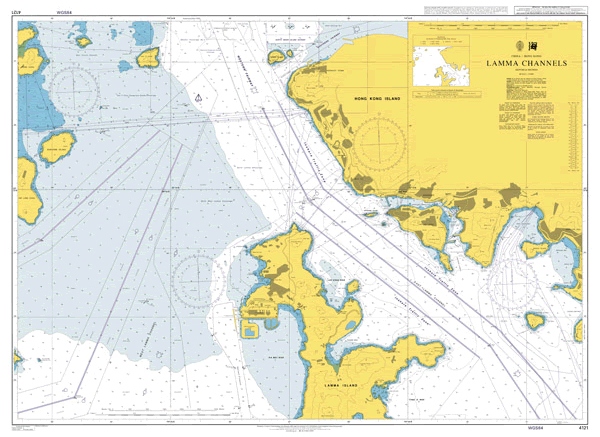
Admiralty Chart of the Area

Report warns of increased danger due to bigger, faster ferries.

A report 15 years ago warned of potential dangers at the location of Monday’s ferry disaster, it was revealed last night.

Approximate Location of the Sea Smooth – Lamma IV Collision

The survey came to light as another unpublished report, completed before the Lamma tragedy, predicted more people would be injured or killed in Hong Kong waters as passenger-carrying vessels get bigger and faster.

The reports emerged at a time when the number of passenger-carrying vessels is expected to increase further when the Kai Tak cruise terminal comes into operation next year.

The 1997 report found that while there were “very few incidents” in and around the East and West Lamma channels, the area was home to “local situations that warrant attention”.

It continued: “These include returning pleasure craft [vessels that carry up to 60 people] from either Lamma or Lantau Islands to Aberdeen Harbour tending to bunch just before sunset which may pose additional risk to vessels navigating the East Lamma Channel.”

The recent unpublished report was by Yip Tsz-leung, associate director and co-founder of the CY Tung International Centre for Maritime Studies.

He said the trend for faster, bigger ferries meant that when an accident does happen, the force of the collision is stronger, causing more injuries and possibly death. He said: “There are fewer cargo ships in the harbour.

“On the other hand, we have more passenger ships which are more frequent, bigger and faster.

“More people may pass away as the impact of an accident will be very huge.”

Yip said that accidents in the waters around Hong Kong – the second busiest port in terms of ship arrivals – had halved in the last 20 years ago and were on a consistent downward trend.

He said that because there were fewer accidents, people had become complacent and were less vigilant about safety measures, such as knowing where lifejackets were located.

A Marine Department spokeswoman said there was no “clear, upward trend” of more injuries or deaths in port traffic accidents. Since 2000, the average number of collisions per year was 195 and “barring a few more serious cases resulting in casualties, most of the collisions recorded were minor contacts”.

The last time marine officials conducted a comprehensive study of traffic risk in Hong Kong waters was in 2004, when it commissioned a HK$2.5 million report that forecast a five per cent increase in incidents by last year.

The Marine Department said last night in a written reply: “The 1997 report was based on the planning framework at that time, including the Lantau Port, West Lamma Channel and Lamma Breakwater, which have not materialised after the report was completed.

“So it is not appropriate to comment on the information in the 1997 report which might have been overtaken by events.”

Read Full Post »


This from the SCMP.

Failure to comply with guidelines could affect compensation.

Olga Wong, Ada Lee  and  Thomas Chan

082c52924daeb0b3611488e135d020b0.jpg

Fireman and police inspect the Lamma IV yesterday. Hongkong Electric and the vessel failed to keep a passenger list and did not ensure children wore life vests. Photo: David Wong

Hongkong Electric and the sunken vessel it owned breached maritime safety guidelines by failing to keep a passenger list and not ensuring that children were wearing life jackets.

While the breaches may not result in any legal action, it may affect passengers’ chances of claiming insurance.

The Marine Department’s guidelines, formulated for vessels viewing the fireworks display, required coxswains and owners of all vessels to take four measures before the start of the voyage: inform all people on board of the location of the lifesaving equipment and the proper way to don a life jacket; require all children to wear a life jacket at all times; keep a passenger list containing their names; and adhere to the carrying capacity specified in the operating licence.

They won’t compensate for something that could have been under control

“If people had followed the guidelines, [Monday’s] incident would not have been that disastrous,” marine director Francis Liu Hon-por conceded in a radio programme yesterday.

The collision of a public ferry and a motor launch, which was taking Hongkong Electric staff, family and friends to watch the fireworks on National Day, left 38 dead, including five children.

Many of the children wore no life jackets and, as of yesterday, Hongkong Electric had failed to release a full list of passengers.

Two days after the accident, a Hongkong Electric spokeswoman said the company only had a registration list, not a list of those finally on board. She said yesterday that the company had information on 127 passengers involved in the accident, three more than its first announcement of 124 passengers. But the government figure shows a total of 131 people dead or injured.

Liu said the guidelines had been in place for years and were not legally binding.

Paul Law Siu-hung, the president of the International Professional Insurance Consulting Association, said failing to comply with the guidelines could affect the chances, and the amount, of compensation, that a vessel owner could claim from the insurance firm. “Insurance companies will investigate if the owner and captain have done their best to ensure the safety of passengers and to minimise the possible damage,” he said. “They won’t compensate for something that could have been under control.”

He said the responsibility of compensation would shift to Hongkong Electric if the accident was not insured. “The amount would be astronomical, given the numerous deaths and the long recovery process of survivors, who suffered physically and mentally,” Law said.

But Hermine Kay, marketing manager for boat rental company Hong Kong Catamaran Club, said it would be “impossible” for boat companies to obtain a full list of passengers from their customers if it was not required by law, as some people had privacy concerns.

Kay said the company, which rented out two boats for fireworks displays on Monday night, would have informed passengers where the life jackets were stored, but it would have been difficult to force people to wear them.

Li Chi-wai, chairman of the Hong Kong Seamen’s Union, said the guidelines would “mean nothing” if there were no consequences.

Liu said the government could consider turning the guidelines into law if the investigation report recommended it.

Hong Kong & Kowloon Ferry said it had bought insurance with US$500 million coverage for one incident, more than the stipulated requirement of HK$5 million.

The police said the bodies of the 38 dead at the Kwai Chung Public Mortuary had been identified by their families yesterday, but the force declined to estimate how many were still missing.

Ryan Tsui, whose brother died, said the police refused to give out any information about the deceased, forcing his family to rush to each hospital to confirm the death. His niece, 10, who celebrated her birthday on board, is in critical condition.

LIST OF THE DEAD (PRELIMINARY)

Chan Wing-kei, 56, Hui Ka-wai, 24,

Wong Wai-ngor, 56, Tsui Chi-wai, 42,

Yan Tsz-ki, 8, Cheng Yin-lan, 40, (mother of Yan Tsz-ki), Cheng Sin-kam, 64,

Chan Hau-luen, 55, Nicholas Chi-ho Belshaw, 7,

Wendy Ie Hwie, 44, (mother of Nicholas Belshaw),

Wong Pui-lan, 63, Thomas Koo Man-cheung, 24,

Pieta Leung Ka-kit, 23

Read Full Post »
« Newer Posts - Older Posts »